
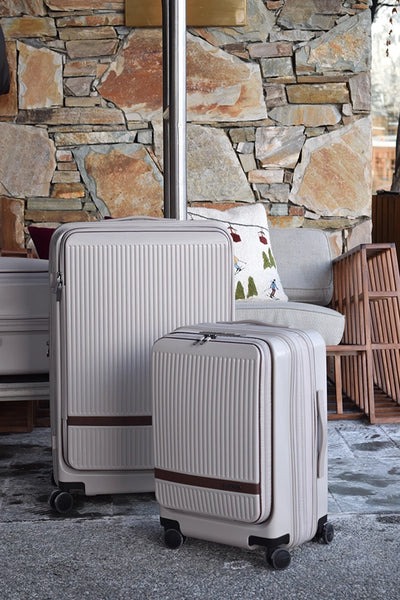
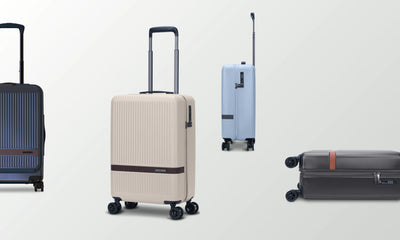

If you are choosing between a top-opening suitcase and a clamshell suitcase, the most useful question is not which design is newer or more popular.
It is how you actually use your suitcase once it is open.
Do you pack with cubes or mostly loose? Do you leave your suitcase open on a luggage rack for three nights, or unpack everything into hotel drawers? Do you regularly stay in compact rooms? Do you like seeing almost everything at once, or would you rather have one deep space you can organise yourself?
Those habits matter more than the label on the case.
The short version is simple:
Top-opening tends to suit packing-cube users, small rooms, luggage racks, bulky items and travellers who live out of the suitcase. Clamshell tends to suit loose packers, travellers who want everything visible at once, and people who prefer two fixed packing zones.
Neither is universally better.
- What is the practical difference when the suitcase is open?
- Top-opening vs clamshell at a glance
- When top-opening tends to work better
- When clamshell genuinely works better
- Does one type of suitcase hold more?
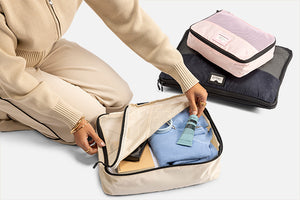
- How packing cubes change the comparison
- Does carry-on vs checked luggage change the answer?
- Which design suits different types of trips?
- So, which should you buy?
- Frequently asked questions
What is the practical difference when the suitcase is open?
A clamshell suitcase splits through the middle into two loaded halves. When you open it fully, both halves need somewhere to go.
A top-opening suitcase keeps most of the packing volume in one deep body beneath a shallow lid. The lid opens away, but the packed contents largely stay within the footprint of the suitcase itself.
That difference sounds small in a showroom. It becomes much more obvious in a hotel room.
Carl Friedrik notes that a clamshell can require roughly twice the opening footprint of a top-lid trunk. Travelpro describes the conventional hard-shell format in similar terms, with two main compartments created by a middle split. LOJEL positions its flat-top Cubo specifically around easier access in tight hotel rooms.
So the first difference is not really about packing at all. It is about space around the suitcase.
The second difference is inside.
A clamshell gives you two shallower sections. A top-opening case gives you one deeper main compartment.
Almost every other advantage or disadvantage flows from those two architectural choices.
Top-opening vs clamshell at a glance
| What matters to you | Top-opening | Clamshell |
|---|---|---|
| Opening footprint | Usually much smaller | Needs room for both loaded halves |
| Small hotel rooms | Strong advantage | Can be awkward |
| Luggage racks | Usually easier to use | Two halves may overhang the rack |
| Visibility | More layered | More visible at once |
| Packing cubes | Particularly well suited | Also works well |
| Loose packing | Can become a deep pile | More intuitive |
| Bulky items | One continuous cavity helps | Centre split can get in the way |
| Two fixed packing zones | You create them yourself | Built in |
| Living out of the suitcase | Often very practical | Depends on space available |
| Fully unpacking at destination | Little difference | Little difference |
| Laptop access in carry-on | Depends on separate front pocket | Depends on separate front pocket |
The comparison becomes easier when you stop asking, "Which suitcase is better?" and ask, "Which inconvenience bothers me more?"
When top-opening tends to work better
You stay in small rooms
This is the clearest advantage.
A conventional 50/50 clamshell needs enough space for both packed halves when it is open. A top-opening suitcase generally stays within roughly the same floor footprint as the closed case.
That matters in compact European hotels, Japanese business hotels, cruise cabins and shared rooms where floor space disappears quickly.
It also matters on luggage racks.
Zoomlite reviews repeatedly mention small hotel rooms and luggage racks, which reinforces opening footprint as a real buying consideration rather than a theoretical difference.
If you often leave your suitcase open beside the bed, this is not a minor difference. It changes how much of the room your luggage occupies every day.
You use packing cubes
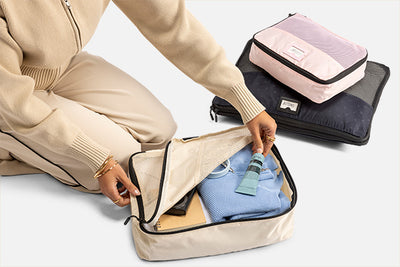
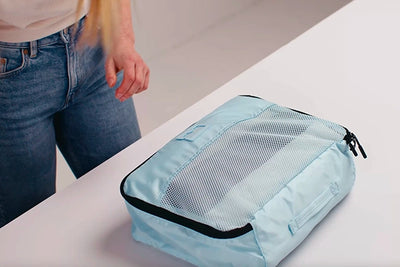
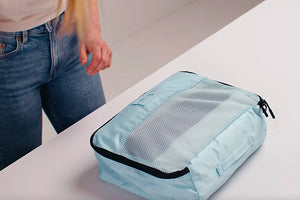
Packing cubes make top-opening more compelling because they give structure to the single deep cavity.
Instead of loose layers, you can move whole modules in and out. That reduces the biggest organisational disadvantage of a deep compartment, although lower cubes still sit beneath upper ones.
That is why packing cubes can change the top-opening vs clamshell decision so much. We look at that comparison in more detail below.
You live out of your suitcase
Some travellers unpack everything. Others treat the suitcase as a portable chest of drawers.
If you are in the second group, a top-opening case can be particularly convenient.
You can leave most cubes in place, remove only what you need, keep laundry contained, and close the suitcase without rebuilding two loaded halves every time.
That becomes useful when you move accommodation frequently or stay only a night or two in each place.
If you completely unpack into hotel drawers, this advantage mostly disappears.
You pack bulky or irregularly shaped items
A deep uninterrupted compartment gives you more freedom to work around a bulky jumper, boots, jackets, a large toiletry case or an awkward souvenir.
Carl Friedrik makes the same distinction when comparing its clamshell cases with trunk-style luggage, noting that the centre split can be less convenient for bulky or irregular items.
That does not mean a top-opening suitcase automatically holds more. It means the usable space is shaped differently.
When clamshell genuinely works better
Top-opening solves some real travel problems, but clamshell remains popular for good reasons.
You want to see everything at once
Open a clamshell and you immediately have two shallow packing areas in front of you.
That makes it easier to scan the contents without moving layers. Travelpro specifically identifies this as one of the advantages of middle-opening luggage.
A deep top-opening case is more vertical. The item you want may be under another layer.
If visual access matters more to you than floor space, clamshell has the advantage.
You pack loose
A clamshell provides organisation even before you add cubes.
There is a left side and a right side. Compression panels, dividers and zipped sections usually reinforce that separation.
A top-opening cavity asks you to create more of the organisation yourself.
For an organised cube user, that can be a benefit. For someone who prefers to throw clothes directly into the suitcase, the same cavity can become a deep pile.
You like two separate packing zones
Some travellers naturally divide a case into categories.
One side might be clothes, the other shoes and toiletries. One side might be one traveller, the other their partner. One half might hold clean clothes while the other becomes laundry on the return journey.
Clamshell gives you those two zones automatically.
You can create similar separation in a top-opening case with cubes and pouches, but the suitcase itself does not do it for you.
Does one type of suitcase hold more?
Not necessarily.
Opening architecture changes the shape of the usable space, not automatically the number of litres.
A top-opening suitcase may feel more spacious because there is no centre split running through the main cavity. That can make bulky items easier to place.
But two cases with similar external dimensions can still have different usable capacity because of:
- trolley-handle rails;
- wheel housings;
- compression panels;
- internal pockets;
- dividers;
- laptop compartments;
- frames;
- expansion systems;
- shell geometry.
So "top-opening holds more" is too broad a claim.
The better question is whether the interior shape suits what you pack.
If you regularly travel with cubes and bulky clothing, one deep cavity may be easier to use. If you pack smaller items and prefer two clear sections, clamshell may make the available volume easier to manage.
How packing cubes change the comparison
Packing cubes narrow the gap between the two architectures.
Without cubes:
- clamshell has more built-in organisation;
- top-opening has more flexible uninterrupted space.
With cubes:
- clamshell becomes two organised shallow zones;
- top-opening becomes a stack of removable organised modules.
That second system is what makes top-opening especially compelling for some travellers.
Instead of asking the suitcase to divide everything for you, you decide what each module contains and where it sits.
For example:
Top layer: sleepwear, first-night clothes, toiletries
Middle: tops, underwear, trousers
Bottom: jackets, shoes, low-frequency items
The arrangement does not need to be complicated. The point is simply that cubes give a deep cavity a structure.
If you never use packing cubes and have no interest in starting, clamshell may remain the more intuitive option.
Does carry-on vs checked luggage change the answer?
Yes.
Checked luggage
With a larger check-in case, the opening architecture becomes more noticeable.
A large clamshell takes up substantial room when fully open. The larger volume also makes one deep top-opening cavity particularly useful for packing cubes and bulky items.
For checked luggage, the strongest top-opening arguments are usually:
- hotel-room footprint;
- luggage-rack use;
- cube organisation;
- bulky-item flexibility;
- living out of the case.
Carry-on luggage
Carry-on adds another question: what do you need while you are moving?
A laptop, passport, tablet, charger or headphones may matter before you ever open the main packing compartment.
That is why a separate front pocket can be more important on a carry-on than on a check-in case.
The front pocket and the main suitcase architecture are separate decisions.
If a suitcase is described as front-opening, our guide to front-opening and dual-access luggage explains what that can mean.
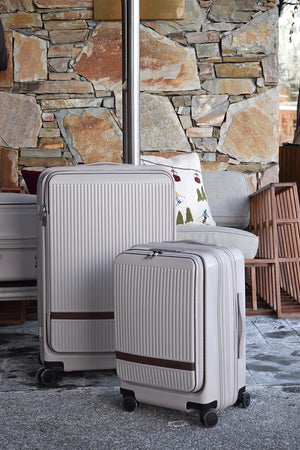
For example, Zoomlite's Glide Elite Carry-On Pro combines a top-opening main compartment with a front tech pocket. The Glide Carry-On Pro combines a front pocket with a clamshell main compartment.
So choosing a carry-on is not simply "top-opening or clamshell". It can also be:
Which main packing architecture do I prefer, and do I need separate quick access?
Which design suits different types of trips?
Small European or Japanese hotel
Top-opening advantage.
You are more likely to notice the smaller opening footprint, particularly if the suitcase remains open during the stay.
Cruise cabin
Top-opening advantage.
Cabins can be tight, and luggage racks or limited floor space make a shallow lid easier to manage.
Road trip
Either can work well.
If you repeatedly open the suitcase for one or two items, a top-opening case with cubes can be convenient. If you unpack into accommodation at each stop, the difference becomes smaller.
Family travel
Depends on how you divide the load.
Top-opening plus colour-coded or labelled packing cubes can create a modular family system. Clamshell can work better if you naturally divide the case between two people or two categories.
Business travel
Carry-on access may matter more than the main opening.
If you need a laptop or documents constantly, focus first on the quick-access pocket. Then choose top-opening or clamshell for the main compartment based on your packing preference.
So, which should you buy?
Choose top-opening if the things that frustrate you most are:
- needing too much room to open a suitcase;
- clamshell cases hanging off luggage racks;
- packing bulky items around a centre split;
- repeatedly opening and closing a case during short stays;
- wanting packing cubes to behave like removable drawers.
Choose clamshell if you care more about:
- seeing almost everything at once;
- packing loose without creating a deep pile;
- having two built-in packing zones;
- dividing belongings naturally between two sides.
And if you fully unpack at every destination, the difference may matter much less than other features such as weight, wheels, warranty, handle design and overall capacity.
The useful decision is not "Which suitcase is better?"
It is:
When my suitcase is open, which layout will make the way I travel easier?
If top-opening sounds like the better fit, you can see the range in our top-opening suitcases.
Is top-opening luggage better than clamshell luggage?
Not for everyone. Top-opening generally works better in tight spaces and is particularly well suited to packing cubes and bulky items. Clamshell gives you better immediate visibility and two built-in packing zones.
Does top-opening luggage use less room when open?
Yes, compared with a conventional 50/50 clamshell. A top-opening case generally opens within roughly the footprint of the suitcase body, while a clamshell needs room for both loaded halves.
Is clamshell luggage easier to pack?
It can be, especially if you pack loose. The two shallow sections provide built-in organisation. Top-opening becomes much easier to organise when you use packing cubes.
Is it difficult to reach the bottom of a top-opening suitcase?
It can take an extra step. You may need to lift out items or cubes above what you want. Packing cubes make that process more organised but do not eliminate it.
Does a top-opening suitcase hold more than a clamshell?
Not automatically. Actual capacity depends on the dimensions and internal construction of the individual suitcase. Top-opening gives you one continuous cavity, which can make bulky items easier to pack.
Which is better for a small hotel room?
Top-opening usually has the advantage because it does not need two loaded halves spread across the floor or bed.
Which is better for carry-on luggage?
It depends on your priorities. The main opening affects packing, but quick access to a laptop and documents may matter just as much. Look at the front-pocket design separately from whether the main compartment is top-opening or clamshell.


Leave a comment