
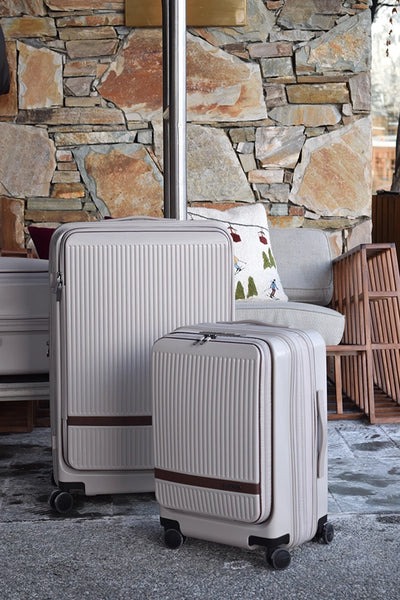
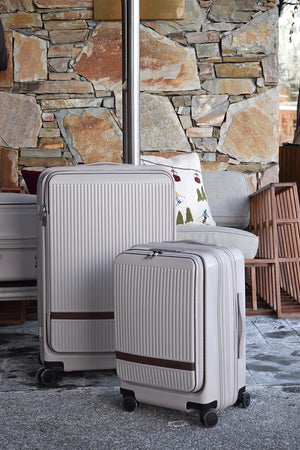
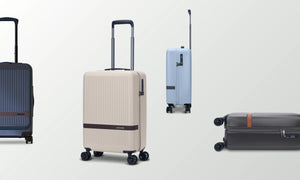

Top-opening luggage may sound like a new idea, but the basic design is very familiar. Traditional soft-sided suitcases typically open through a flat or shallow lid into one deep main compartment. What is unusual is seeing that same layout engineered into a modern hard-shell suitcase.
Modern hard-shell luggage became dominated by a centre-split clamshell design, with two rigid shell sections meeting around the middle. With rigid luggage, the way the suitcase opens is closely tied to how the shell is engineered. The shell, frame and opening all need to remain stable under load.
Top-opening hard-shell luggage takes the familiar single-compartment idea and applies it to a rigid shell. That changes how much room the suitcase needs when open, how you organise the interior, and how easy it is to live out of the case once you arrive.
In this guide, when we say top-opening luggage, we are mainly talking about that modern hard-shell version.
- What is top-opening luggage?
- Five suitcase opening designs that are easy to confuse
- Why top-opening luggage makes sense in tight spaces
- The biggest practical difference: how much room it needs when open
- One deep compartment: the advantage and the problem
- Packing cubes change the equation
- Can you live out of a top-opening suitcase?
- The disadvantages of top-opening luggage
- Top-opening vs clamshell: the short answer
- Is front-opening luggage the same thing?
- When does top-opening luggage make the most sense?
- Does top-opening work differently for carry-on and checked luggage?
- Why do most hard-shell suitcases still open in the middle?
- Frequently asked questions
What is top-opening luggage?
Top-opening luggage is a suitcase where a relatively shallow lid opens onto one deep main packing compartment. Unlike a clamshell suitcase, which divides the case into two loaded halves, most of the usable packing volume sits in one side.
That sounds simple, but luggage terminology is surprisingly messy. You may see similar cases described as top-loading, top-lid, flat-top, front-opening, book-opening or trunk-style. Those labels do not always mean the same thing.
That is worth clearing up before comparing benefits, because a suitcase with a laptop door on the front can be called "front-opening" even though its main compartment is still a conventional clamshell. A true dual-access case is something different again.
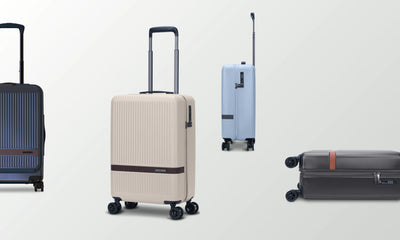
Five suitcase opening designs that are easy to confuse
The easiest way to understand top-opening luggage is to compare the architecture rather than the marketing name.


The important point is that "front-opening" is not a precise architecture. Some brands use it for a shallow-lid suitcase. Others use it for a laptop pocket. Samsonite's Paralux, for example, keeps a traditional middle opening and adds a large front door that accesses the suitcase interior.
The brands named on each card are examples to help you recognise the design, not a ranking.
For this article, we will use top-opening for the shallow-lid, deep-cavity design.
Why top-opening luggage makes sense in tight spaces
The difference becomes much more obvious after you arrive.
A clamshell suitcase is designed to spread into two loaded halves. That works well on a large bed or floor, but it can be awkward when the only place for your case is a narrow luggage rack, a corner of a small hotel room or the gap beside the bed.
A top-opening case keeps most of the load in one body. The lid still needs room to open, but you are not trying to lay two packed halves side by side.
That is the first practical reason this older packing idea has become interesting again in hard-shell luggage.
The biggest practical difference: how much room it needs when open
This is where top-opening luggage earns its strongest argument.
A conventional 50/50 clamshell needs room for both loaded halves when it is fully open. A top-opening suitcase generally opens within roughly the same floor footprint as the closed case. In practical terms, it typically needs about half the opening space of a 50/50 clamshell.
In a spacious bedroom, that may not matter at all. In a small European hotel, a Japanese business hotel, a cruise cabin or a room shared by two travellers, it can make a noticeable difference.
It also changes how well a hard-shell case works on a luggage rack. Many hotel racks can support the body of a suitcase comfortably, but not two rigid loaded halves spread across and beyond the rack.
This is not a problem we had to invent for marketing. It appears repeatedly in Zoomlite customer reviews. One traveller put it plainly:
"I hate the struggle opening the traditional shell style suitcase and then trying to make it open on one of those small luggage racks."
Another customer said the top-opening design let them keep items in the suitcase during short stays in compact rooms instead of repeatedly finding floor space to open a clamshell.
That is useful in the places where luggage is often most annoying: not at the airport, but beside the bed after you arrive.
One deep compartment: the advantage and the problem
The feature that makes top-opening luggage useful is also the feature most likely to annoy you if you pack it badly: one deep compartment.
The advantage is flexibility. There is no centre split dividing the largest packing area in two. That makes it easier to work around bulky clothing, jackets, shoes, larger packing cubes and awkwardly shaped items. Trunk-style cases use the same basic logic to different degrees. July's Checked Trunk, for example, uses an 80/20 layout so most of the depth remains on one side.
But the bottom is still the bottom.
If you loose-pack a deep case and put something important underneath a week's worth of clothes, you will probably have to move those clothes to reach it. A top-opening suitcase does not give instant access to everything inside.
That is the main compromise with a deep single compartment. Clamshell cases have a genuine advantage here: two shallow sections make more of the contents visible at once, and the suitcase itself creates two fixed packing zones.
So the question is not whether one deep compartment is objectively better. It is whether you prefer one flexible space that you organise yourself or two shallower spaces organised by the case.
Packing cubes change the equation
This is where top-opening luggage starts to make much more sense for organised packers.
A clamshell suitcase provides part of its organisation through the suitcase itself. You naturally get a left side and a right side. A top-opening suitcase can shift more of that organisation to removable modules.
Without packing cubes, a deep cavity can become a pile: T-shirts over trousers, underwear beside a jumper, toiletries wedged into a gap.
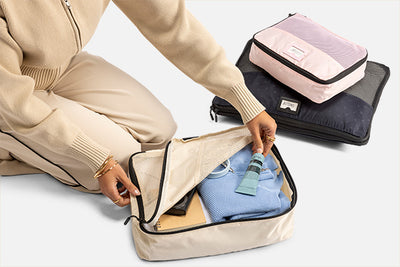
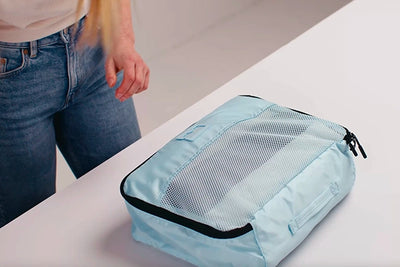
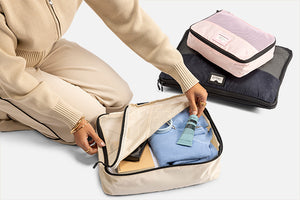
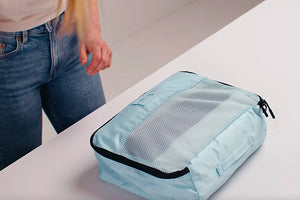
With cubes, the same space becomes a stack of sections. You might have one cube for tops, one for underwear, one for trousers and one for first-night clothes. To reach a lower layer, you lift out one or two complete modules rather than dismantling a loose pile.
Customers discovered this use case independently. One Zoomlite reviewer described it neatly:
"Packing cubes can actually stack like books on a shelf."
Another wrote that the top-opening feature suited the way they already packed with cubes.
That is why we think packing cubes are particularly well suited to top-opening luggage. Not because they magically make the bottom instantly accessible, and not because they only work in this type of suitcase. They give structure to a large uninterrupted compartment.
If you want a step-by-step method, our guide on how to pack a top-opening suitcase shows how to build the layers.
Can you live out of a top-opening suitcase?
If you are someone who rarely uses hotel drawers, top-opening plus packing cubes can work particularly well.
You can leave most cubes in the case, remove only the one you need, keep a separate laundry cube or bag, and repack without rebuilding two sides of a suitcase every time you move hotels.
This is especially useful on short stays where unpacking fully would take almost as long as the stay itself.
It is not an advantage for everyone. If your first move after check-in is to hang every shirt and empty the suitcase into drawers, the opening architecture becomes much less important. Once the case is empty, a clamshell and a top-opening suitcase are simply two empty shells on the floor.
The benefit is strongest for travellers who actually use the suitcase as storage during the trip.
The disadvantages of top-opening luggage
Top-opening is not automatically better luggage. There are several reasons you may prefer a clamshell.
Reaching the bottom takes an extra step.
If the case is full, lower items sit underneath upper ones. Packing cubes make that more orderly, but they do not remove the need to lift something out.
One large compartment does not organise itself.
Loose packers may find two shallow clamshell halves more intuitive. A deep cavity benefits from cubes, dividers, compression panels or a deliberate packing order.
Clamshell gives you more at-a-glance visibility.
Open both sides and much of the load is visible immediately. That can be genuinely convenient when you want to find one item quickly.
Not every "top-opening" design behaves the same way.
A shallow lid, an 80/20 trunk and a full front-door system create different packing spaces. Lid balance, retention straps and internal dividers also vary by model.
Weight and usable capacity are model-specific.
Opening architecture alone does not tell you which suitcase is lighter or which holds more. Handles, rails, frames, pockets, dividers, wheel housings and shell geometry all take up space and add weight.
That last point is important. A top-opening case may feel more spacious because it gives you one continuous cavity, but that does not mean two suitcases with the same external dimensions automatically have the same usable litres.
Top-opening vs clamshell: the short answer
The practical choice comes down to how you pack and how you use the suitcase at your destination.
- Top-opening tends to suit packing-cube users, smaller rooms, luggage racks and travellers who live out of the case.
- Clamshell tends to suit loose packers, people who want more of the contents visible at once, and travellers who prefer two fixed packing zones.
- If you unpack everything as soon as you arrive, the difference may matter much less.
There is no universal winner. The better suitcase is the one that matches what happens after you unzip it.
For a fuller side-by-side comparison, see our guide to top-opening vs clamshell suitcases.
Is front-opening luggage the same thing?
Sometimes, but not reliably.
"Front-opening" is used for several different suitcase designs, including small laptop doors, full front-access doors and shallow-lid cases that are effectively top-opening.
Zoomlite uses top-opening for the shallow-lid, one-deep-cavity architecture because it describes the main packing layout more clearly.
For a closer look at the three designs behind the label, see our guide to front-opening luggage.
When does top-opening luggage make the most sense?
Top-opening tends to work particularly well if you:
- already use packing cubes;
- regularly stay in smaller hotel rooms or cruise cabins;
- keep clothes in your suitcase rather than fully unpacking;
- move accommodation frequently;
- use luggage racks;
- often pack bulky or irregularly shaped items.
A clamshell may suit you better if you:
- usually pack loose;
- want to see almost everything as soon as the case is open;
- like two clearly separated packing zones;
- fully unpack at each destination.
The decision becomes slightly different again with carry-on luggage.
Does top-opening work differently for carry-on and checked luggage?
Yes, because the job of the suitcase changes.
With checked luggage, the strongest arguments for top-opening are usually at the destination: opening footprint, luggage-rack use, deep packing space and the ability to organise a larger load with cubes.
With carry-on luggage, airport access matters more. You may want a laptop, tablet, passport, charger or jacket without opening the main packing compartment at all.
That is why carry-on architecture is becoming more mixed. A suitcase can combine a top-opening main cavity with a separate front pocket, as Zoomlite's Glide Elite Carry-On Pro does. A traveller who prioritises laptop access may equally prefer a conventional clamshell with a well-designed exterior tech pocket, or a dual-access model.
Top-opening is one solution. Carry-on use makes it clear why it should not be treated as the only solution.
Why do most hard-shell suitcases still open in the middle?
This is where the engineering matters.
There is no single documented reason that explains the whole history of hard-shell luggage, but rigid-suitcase construction has long been built around two shell sections joined and reinforced around a frame or perimeter. Suitcase patents going back decades describe rigid shells fixed to stiffening frames and hinged together. Carl Friedrik also points to frame reinforcement as one reason the centre-opening format is durable.
That makes the centre split more than a packing choice. It is part of the structure of the case.
The familiar packing benefits come afterwards: two shallower sections, easy visual access and natural separation between sides.
Top-opening hard-shell luggage has to solve the structural problem differently. It needs a large rigid body plus an opening and lid that remain stable under load. Different brands handle that in different ways through shell geometry, framing and reinforcement around the opening.
None of this means clamshell is outdated or top-opening is inherently stronger. It explains why the apparently simple idea of putting a soft-luggage-style lid on a hard-shell suitcase is not quite as simple as it looks.
Is top-opening luggage better than clamshell luggage?
Not universally. Top-opening tends to suit travellers who use packing cubes, stay in small rooms or live out of their suitcase. Clamshell often suits loose packers and people who prefer two shallow, fully visible packing zones.
Does top-opening luggage hold more?
Not inherently. A single deep cavity can be easier to use for bulky items, but actual capacity depends on the dimensions, shell shape, handles, rails, dividers, pockets and internal hardware of the individual suitcase.
Is it harder to reach things at the bottom?
It can be. If the case is tightly packed, you may need to lift out items above the one you want. Packing cubes make this much more orderly because you move whole modules instead of digging through loose clothing.
Does top-opening luggage work particularly well with packing cubes?
Yes. Packing cubes give structure to the large uninterrupted compartment, which makes layers easier to remove and replace. They are useful in any suitcase, but particularly well suited to the way a top-opening cavity is packed.
Is front-opening luggage the same as top-opening luggage?
Sometimes brands use the terms interchangeably, but not always. "Front-opening" can also describe a laptop pocket or a full front door on a dual-access suitcase.
Can you use a top-opening suitcase on a luggage rack?
Often, yes, and this is one of its practical advantages. The rack still needs to be large and stable enough to support the suitcase body, but you do not need to support two loaded clamshell halves spread across it.
The most useful question is not whether top-opening luggage is "better". It is simpler: where will your suitcase sit when it is open, and how do you want to use what is inside it? That answer usually tells you which architecture makes more sense.


I need to know if the carry-on is top- opening because it’s not very clear. In the article, you say the Neos collection is top-opening, but then the description for the carry-on mentions that it has a split bookstyle opening, which is not the same. Show someone packing clothes into the carry-on please.
Do the neos cases fit into each other (nest) for storage purposes when not in use ??
it would be great if there was some clear photos of the interior of the neos case
Sounds perfect as long as they are not plain black!
Could you post a video of the suitcase being packed and used please
Leave a comment