

Search for "front-opening luggage" and you can end up looking at three completely different suitcases.
One may have a small front pocket for a laptop while the main case still opens like a clamshell. Another may have a full front door that gives you access to the entire suitcase as well as a conventional centre split. A third may have one shallow lid opening into a deep main compartment.
All three can be described as front-opening.
That is the problem.
There is no consistently used market label that tells you exactly how a suitcase is built just from the words "front-opening". The useful question is not what the brand calls it. It is what part of the suitcase opens, and what can you reach through that opening?
Once you answer that, the category becomes much easier to understand.
- What does front-opening luggage actually mean?
- Why is the terminology so confusing?
- Design 1: the front-pocket carry-on
- Design 2: the full front door or dual-access suitcase
- Design 3: top-opening or shallow-lid luggage
- Front pocket, dual access or top-opening: what is the actual difference?
- Is front-opening luggage the same as top-opening luggage?
- What does dual-access luggage mean?
- Which front-opening design should you choose?
- How Zoomlite uses these terms
- Frequently asked questions
What does front-opening luggage actually mean?
In practice, "front-opening luggage" is commonly used for three different designs:
- Front-pocket carry-on: a smaller front door gives access to a laptop, documents or travel essentials. The main suitcase still opens separately, often as a clamshell.
- Full front-door or dual-access luggage: a large front door gives access to most or all of the main compartment, while the suitcase may also retain a conventional centre-split opening.
- Top-opening or shallow-lid luggage: one large lid opens into a deep main packing compartment. Some brands describe this as front-opening or front-loading even though the case effectively opens from the top when standing upright.
These designs solve different problems. A laptop pocket is about quick access in transit. A full front door adds another route into the main compartment. A top-opening layout changes the architecture of the main packing space itself.
That distinction matters more than the label.
Why is the terminology so confusing?
Because brands describe luggage from different points of view.
Some name the location of the door. Some describe the direction you access the suitcase from. Others describe the internal layout.
The same architecture can therefore end up with different names.
Away's Topside is a particularly good example. Away calls it a "front-loading Carry-On", but the same product description says it "opens from the top" and uses a "top lid opening". LOJEL calls the Cubo a "flat-top opening". LEVEL8 uses "top opening". Zoomlite uses "top-opening" for the same broad shallow-lid, deep-compartment idea.
Samsonite uses "front door" differently again. Its Paralux luggage retains the traditional middle split and adds a large front door that accesses the suitcase interior. Samsonite calls that dual access.
So two suitcases can both be described as "front-opening" while having fundamentally different interiors.
A useful rule is:
Ignore the label for a moment. Look at what happens to the main packing compartment when you open the case.
That tells you what you are really buying.
Design 1: the front-pocket carry-on
This is the simplest form of front access and the easiest to confuse with true front-opening luggage.
A front-pocket carry-on has a separate door or pocket for items you may want during the journey, such as:
- a laptop;
- a tablet;
- travel documents;
- headphones;
- a charger;
- smaller personal items.
The key point is that the front pocket does not necessarily change how the main suitcase opens.
You can have a completely conventional clamshell suitcase with a laptop door on the front. You can also have a top-opening suitcase with a separate front pocket.
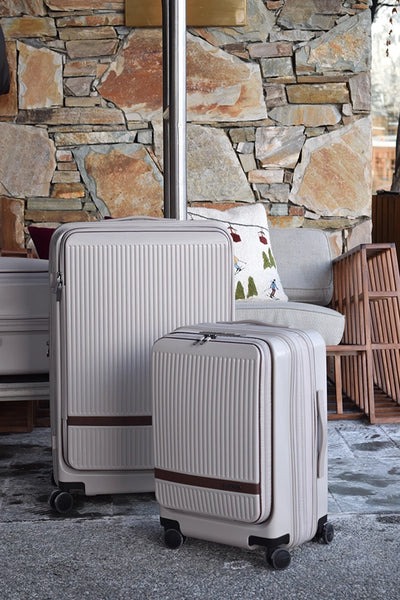
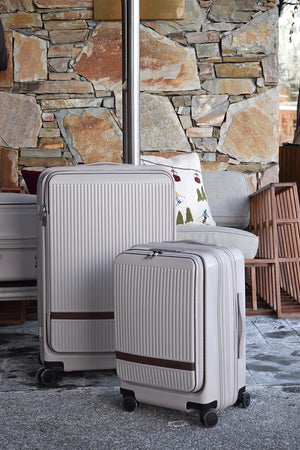
Zoomlite's Glide Elite Carry-On Pro is an example of the second arrangement. Its main packing cavity is top-opening, with one deep compartment, while a separate front pocket keeps a laptop, tablet and travel essentials accessible without opening the main case. The Zoomlite Glide Carry-On Pro is the contrasting example: it also has a front pocket for quick access, but its main packing compartment uses a clamshell opening.
What problem does it solve?
Quick access.
This design makes the most sense when the items you need at the airport, on the train or in a hotel lobby are different from the clothes and packing cubes in the main compartment.
What does it not solve?
A front pocket does not automatically reduce the opening footprint of the main suitcase.
If the underlying case is still a 50/50 clamshell, you still need room to open those two halves when you want to access your clothes.
That is why "has a front pocket" and "front-opening luggage" should not be treated as the same thing.
Design 2: the full front door or dual-access suitcase
This is a much more significant architectural change.
A full front-door suitcase gives you access to the main packing compartment through a large door on the front of the case. Some designs also retain the conventional centre split, so there are two different ways into the suitcase.
Samsonite's Paralux is a clear current example. Samsonite describes it as dual access because you can open the case through the traditional middle split or through a full front door. The company specifically positions the front door as useful when floor space is limited.
This approach tries to give you two benefits:
- the familiar two-sided packing structure of a conventional suitcase;
- another way to reach the interior without laying both halves fully open.
TUMI also uses the term "dual access" on luggage that can be opened through a front lid or through a split-case entry.
What problem does it solve?
Flexibility.
You can choose the opening that suits the situation. At home, you may use the full split while packing. In a tight hotel room, you may use the front door.
What is the trade-off?
More access usually means more architecture.
A second large opening can require extra zips, locks, dividers, panels or reinforcement. That can affect weight, usable space and complexity, but the effect varies by model. It is not accurate to assume every dual-access suitcase is heavier or holds less.
The right comparison is always between the actual cases, not the label.
Design 3: top-opening or shallow-lid luggage
This is the architecture Zoomlite means when we use the term top-opening luggage.
Instead of dividing the main case into two similar halves, a relatively shallow lid opens onto one deep packing compartment.
The idea itself is familiar. Traditional soft-sided luggage commonly uses a similar arrangement. What is less common is engineering that single-cavity layout into a rigid hard-shell spinner.
This is also the design most likely to be described inconsistently.
Current brands use several terms for versions of it:
- Zoomlite: top-opening
- LEVEL8: top opening
- LOJEL Cubo: flat-top opening
- Away Topside: front-loading, while also describing the case as opening from the top
That variation is exactly why the words "front-opening" are not enough to tell you how a suitcase works.
What problem does it solve?
It changes both the opening footprint and the packing layout.
Most of the luggage remains in one main body rather than spreading across two loaded halves. That makes the case easier to open in smaller hotel rooms and on many luggage racks.
Inside, you get one deep uninterrupted packing compartment. That works particularly well with packing cubes and bulky items, but it also means lower items sit beneath upper ones.
For the full explanation of that architecture, see our guide to Top-Opening Luggage: Pros, Cons & Is It Right for You?.
Front pocket, dual access or top-opening: what is the actual difference?
| Design | What opens from the front or top? | Main compartment | Main benefit | Main limitation |
|---|---|---|---|---|
| Front-pocket carry-on | Small laptop or essentials pocket | Usually separate from the main case | Quick access during travel | Does not necessarily change the main suitcase opening |
| Full front door / dual access | Large door into the main interior | Often also accessible through a centre split | Multiple ways to access the same suitcase | Extra access architecture can add complexity |
| Top-opening / shallow lid | Large shallow lid | One deep main compartment | Smaller opening footprint and flexible packing space | Bottom items may require lifting out what sits above |
This is the simplest way to read the market.
If the "front opening" only reaches a laptop, it is a front pocket.
If the front door reaches the main interior and the suitcase can also open another way, it is dual access.
If the large lid itself is the main opening and it reveals one deep compartment, it is top-opening, even if the brand chooses to call it front-loading or front-opening.
Is front-opening luggage the same as top-opening luggage?
Sometimes, but not reliably.
A shopper searching for front-opening luggage may be looking for a top-opening suitcase because both let you access the case from one side rather than spreading two halves across the floor.
But the term can also lead to a laptop-pocket carry-on or a dual-access suitcase.
That is why Zoomlite uses top-opening as the house term for a shallow-lid suitcase with one deep main cavity.
It describes the architecture more clearly.
We use front pocket for a smaller quick-access compartment and dual access when the main packing compartment can be reached through two substantial openings.
That vocabulary is not universal across the industry, but using the terms consistently makes it easier to compare products.
What does dual-access luggage mean?
Dual access means you have two meaningful ways to reach the main packing area.
That is different from simply having an exterior pocket.
Samsonite Paralux demonstrates the distinction clearly. The suitcase can open through its traditional centre split, but its large front door also accesses the full suitcase interior.
TUMI uses similar language for models with front-lid and split-case entry to the main compartment.
The advantage is choice. You do not have to commit to one opening architecture every time you use the case.
But dual access should not automatically be treated as a more advanced version of top-opening luggage. It is a different solution.
Top-opening simplifies the main cavity into one deep space. Dual access preserves more of the traditional suitcase structure while adding another route in.
Which front-opening design should you choose?
Start with the access problem you are trying to solve.
You mainly want your laptop and documents within reach
Look for a front-pocket carry-on. You may not need a different main packing architecture at all.
You want the main case to open in less space
Look at top-opening or dual-access designs. They solve the space problem in different ways.
You want one deep compartment for packing cubes or bulky items
Look for top-opening / shallow-lid luggage.
You want two substantial ways into the main suitcase
Look for dual-access luggage.
If you are choosing between top-opening and a conventional clamshell, compare those two main architectures directly rather than using "front-opening" as shorthand.
How Zoomlite uses these terms
Because the market language is inconsistent, we think it is more useful to describe the architecture rather than use "front-opening" as a catch-all.
At Zoomlite:
Top-opening means the main suitcase has a shallow lid opening into one deep packing compartment.
Front pocket means a separate quick-access compartment for items such as a laptop, tablet or passport.
Dual access means the main compartment has two substantial access routes.
This distinction matters on products such as the Glide Elite Carry-On Pro. It has both a top-opening main compartment and a quick-access front pocket. Calling the entire suitcase simply "front-opening" would blur two separate features.
The clearer the language, the easier it is to choose a suitcase for the way you actually travel.
What is a front-opening suitcase?
It depends on the brand. The term may describe a suitcase with a small front pocket, a full front door into the main compartment, or a shallow-lid top-opening design. Check what part of the suitcase the front opening actually accesses.
Is a front-pocket carry-on the same as front-opening luggage?
Not necessarily. A front pocket usually gives quick access to a laptop or travel essentials while the main suitcase opens separately. The main compartment may still be a conventional clamshell.
Is top-opening luggage front-opening?
Some brands use the terms that way. A shallow-lid top-opening suitcase can appear to open from the front when it is standing upright, which is one reason the language overlaps. Zoomlite uses "top-opening" because it more clearly describes the main architecture.
What is dual-access luggage?
Dual-access luggage gives you two substantial ways to reach the main packing compartment. For example, a suitcase may retain a centre-split opening while also adding a full front door.
Does front-opening luggage save floor space?
It depends on the design. A top-opening suitcase generally reduces the space needed to open the main case. A dual-access front door can also reduce the need to spread the case fully open. A small laptop pocket on a clamshell does not change the opening footprint of the main compartment.
Is one design better?
No. A front pocket is best for quick-access items. Dual access gives you more choice in how you open the suitcase. Top-opening gives you one deep main compartment and a smaller opening footprint. The better option depends on what you want access to and how you prefer to pack.


Leave a comment