
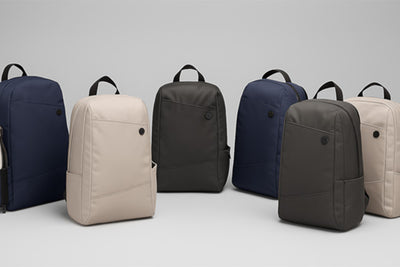
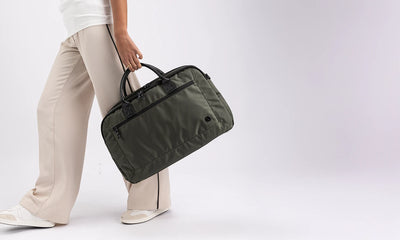
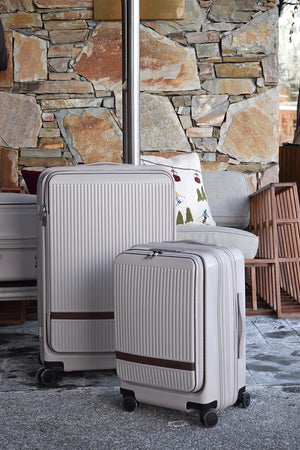
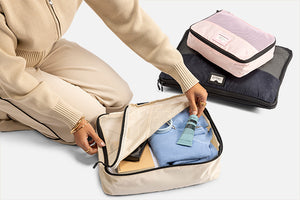
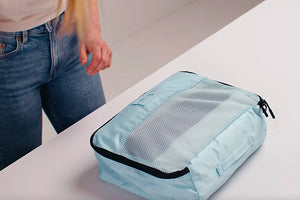
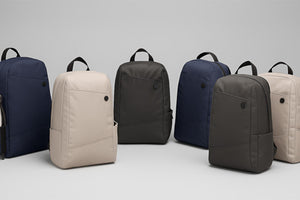
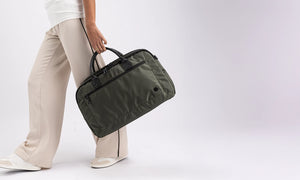

Security should not make a travel bag look tactical or feel difficult to use. That is the idea behind Quiet Protection: the security features sit inside an everyday-looking bag and work in the background while you move through airports, stations, markets, public transport and normal daily life.
At Zoomlite, the system is explained in four layers: Lock, Slash-Proof, Block, Conceal. They address different kinds of access rather than relying on one feature to do everything.
The names are deliberately simple. The construction underneath them is more precise: lockable zippers make key compartments harder to open unnoticed; UHMWPE reinforces vulnerable panels; selected straps use a concealed steel cable for added cut resistance; RFID-lined pockets provide passive shielding; and concealed pockets place important items closer to the body or out of obvious view. None of these makes a bag theft-proof. They are layers designed to make casual access more difficult without changing how the bag looks or feels to carry.
Zoomlite's Quiet Protection uses four layers: Lock for secure zipper access, Slash-Proof for cut-resistant panels and, on selected bags, reinforced straps, Block for RFID-shielded storage, and Conceal for discreet pockets. “Slash-Proof” is the system label; the materials themselves are correctly described as slash-resistant or cut-resistant, not indestructible.
What Quiet Protection means
“Anti-theft” is a broad category term. Different bags use different combinations of secure closures, reinforced materials, RFID shielding and hidden storage, so the label alone does not tell you how a particular bag is built.
Quiet Protection is Zoomlite's way of making that construction easier to understand. Lock controls access to key compartments. Slash-Proof reinforces vulnerable areas against quick cutting attempts. Block adds passive RFID shielding. Conceal gives selected essentials a less obvious place to sit.
The exact execution varies by style. A crossbody and a backpack do not need identical hardware, and a concealed rear pocket may work differently from an internal hidden pocket. The useful question is not whether every model has the same checklist in the same place; it is how the security features work with the way that bag is actually carried.
1. Lock: lockable zipper access
Lock is about adding a deliberate extra step before a key compartment can be opened. Depending on the style, zipper pulls clip to a loop, bridge or anchor point so the compartment does not open with one casual pull.
How to use it: secure the main compartment when you are moving through airports, public transport, markets or other busy places. Leave quick-access pockets unsecured only when that trade-off makes sense for what you keep inside.
What it does: discourages unnoticed, casual opening by making access less immediate.
What it does not do: turn the zip into a safe or make the compartment impossible to open with time and tools.
2. Slash-Proof: cut-resistant panels
In the Quiet Protection system, Slash-Proof is the simple customer-facing name for cut-resistant construction. The material itself is better described as slash-resistant or cut-resistant, because no soft bag is impossible to cut.
What does “slash-resistant” actually mean?
“Slash-resistant” is easy to put on a product page. The more useful question is: what has actually been built into the bag to resist a blade?
A tougher outer fabric can improve everyday durability, but a high denier number is not a cut-resistance rating. Denier measures the weight of the yarn: the number tells you how many grams 9,000 metres of that yarn weighs. It does not tell you how a finished bag will perform against a blade.
What sits beneath the outer fabric matters


Illustrative layer diagrams. Actual materials, coverage and construction vary by product.
Two established approaches used in purpose-built anti-theft bags are a metal mesh barrier and a dedicated high-performance fibre reinforcement. Pacsafe, for example, describes its eXomesh system as a stainless-steel wire barrier built into vulnerable areas. Travelon describes an embedded slash-resistant mesh barrier in its body panels, with stainless-steel cables used in selected straps.
Zoomlite takes the second approach. We place a woven UHMWPE reinforcement layer behind vulnerable panels. UHMWPE stands for ultra-high-molecular-weight polyethylene, a high-performance fibre used where high strength and cut resistance are important. Because the reinforcement is a textile layer rather than a metal mesh, the bag can remain soft, flexible and lightweight.
Neither approach makes a soft bag impossible to cut. The point is to add a purpose-built layer of resistance against a quick cutting attempt.
So when comparing bags described as slash-resistant or slash-proof, look beyond the label:
- Is there a dedicated reinforcement layer behind the outer fabric?
- What is that layer made from?
- Which parts of the bag are actually protected?
- Does the brand explain the construction, or only quote the denier of the outer fabric?
If the only evidence offered is a thicker or high-denier outer material, that may tell you something about general durability. It does not, by itself, demonstrate cut resistance.
How to use it: you do not need to activate anything. The reinforced panel works passively while you carry the bag.
What it does: adds resistance to a quick cutting attempt through a protected panel.
What it does not do: make the bag indestructible. Coverage also depends on the product, so check the feature details for the specific style you are considering. We explain the material in more depth in our cut-resistant fabric guide.
Reinforced straps on selected bags
Selected Zoomlite crossbody bags add a concealed steel cable inside the shoulder strap. It sits within the strap rather than being visible from the outside, adding cut resistance without turning the strap into a rigid cable.
This is a product-specific feature, not something to assume from the category name alone. Backpacks and other styles may use a different security construction, so check the individual product specification.
How to use it: wear a crossbody in the position that feels natural and gives you good control of the bag. In very crowded places, bringing the bag toward the front can make the zips and main compartment easier to monitor.
What it does: adds resistance to a quick cut through the reinforced section of the strap.
What it does not do: prevent someone taking an unattended bag, or make it sensible to resist a forceful robbery. Personal safety comes first.
3. Block: RFID-blocking storage
Block is the passive RFID layer. A marked RFID pocket is lined with shielding material designed to reduce close-range unauthorised reading while an RFID-enabled card or e-passport is stored inside.
RFID protection is one extra layer rather than a complete security system. It does not protect against physical theft, phishing or card details entered online.
How to use it: put the cards or passport you want shielded inside the marked RFID pocket. The whole bag is not necessarily RFID-blocking.
What it does: provides passive shielding while the item is stored correctly.
What it does not do: protect card details after you enter them online, prevent physical theft of the card, or replace normal banking security.
4. Conceal: pockets that are less obvious to access
Conceal is the simplest layer in the system. Instead of putting every important item in an obvious front pocket, selected Zoomlite styles include pockets positioned against the body, behind another compartment or otherwise out of immediate view.
A concealed pocket is useful for items you want with you but do not need to reach constantly: a passport, backup card, spare cash or hotel key, depending on the size and layout of the bag.
How to use it: reserve the concealed pocket for higher-value or backup items rather than things you need every few minutes. That keeps you from repeatedly opening the most protected storage in public.
What it does: makes the storage location less obvious and, depending on its position, physically harder to reach while you are wearing the bag.
What it does not do: lock the item in place or make the pocket inaccessible if the whole bag is taken. Concealment works best alongside the other layers, not instead of them.
Where Quiet Protection stops
Quiet Protection is designed for everyday risk reduction, not absolute security. The features make casual access more difficult and give important items a more considered place to sit, but they do not make a bag impossible to steal or open.
An unattended bag can still be picked up. A lockable zipper can still be opened with enough time or tools. Cut-resistant materials can still be defeated with enough force. RFID shielding only works for items stored inside the shielded pocket.
And if someone threatens you directly, the priority is not the bag. Move to safety and give up property rather than escalating a confrontation.
Whether the extra security is useful depends on how you travel. It is most relevant when you regularly carry a passport, cards, phone or other important items through airports, public transport and busy urban places. If your bag spends most of a trip in a car or hotel room, those features may matter less. We explore that decision separately in Do Anti-Theft Bags Actually Help Prevent Theft?.
How you carry the bag still matters. A crossbody keeps key compartments within easy reach and can be moved toward the front in crowded places. A backpack gives you more capacity, but because it sits behind you, secure closures and concealed storage become especially useful. The right choice depends on capacity, comfort and how you move through the day, not simply the length of the feature list.
The takeaway
Quiet Protection is not one trick. It is a layered approach: make important compartments harder to open casually, reinforce vulnerable areas, give RFID-enabled items a shielded place and keep selected essentials out of obvious view.
The exact combination varies across the Zoomlite anti-theft range, so check the features of the individual bag rather than assuming every style uses identical construction. The aim is the same across the range: security that does not announce itself, built into bags designed for normal travel and everyday carry.
For the behaviour that sits around the bag, our 50 travel safety tips covers documents, payments, airports, transport and what to do if something goes wrong.
What makes a bag anti-theft?
There is no single universal feature. Zoomlite's Quiet Protection combines four layers: Lock, Slash-Proof, Block and Conceal. In practical terms, that means secure zipper access, cut-resistant construction, RFID-blocking storage and concealed pockets. The exact execution varies by bag.
What is the cut-resistant material?
Zoomlite uses a hidden UHMWPE reinforcement layer in vulnerable panels. It sits behind the outer fabric, so the protection is built into the bag rather than added as a visible hard layer. Coverage varies by product.
Can an anti-theft bag be cut open?
Yes, given enough force, time or the right tools. “Slash-Proof” is the name of the Quiet Protection layer; the construction itself should be understood as cut-resistant, not indestructible.
Do I really need RFID-blocking pockets?
They are optional extra protection. RFID shielding can reduce close-range unauthorised reading while a compatible card or e-passport is stored inside, but it does not protect against physical theft, phishing or card details entered online.
Are anti-theft bags worth it?
They are most useful when you regularly carry important items through airports, public transport and busy urban places. If your travel is lower-risk or the bag is rarely on your body, the extra security features may matter less. Our guide to whether anti-theft bags actually help goes through that decision in more detail.


Leave a comment