
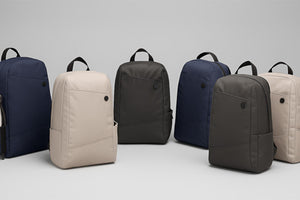

Carry-on backpacks make travel easier in one obvious way: they keep your hands free. You can move through airports, train stations, hotel lobbies and city streets without dragging a suitcase behind you. Everything you need is on your back, and you can move quickly when the trip demands it.
But many carry-on backpacks have a fundamental design flaw. They are built like a black hole.
Everything goes into one deep compartment. Then, when you need something from the middle or bottom, you have to rummage blindly. The charger gets misplaced. The clean shirt gets crushed. The neat packing system you built at home starts to collapse.
A clamshell backpack fixes this by opening like a suitcase. It turns one deep compartment into two open halves, so you can see what you packed, organise it properly, and take out what you need without disturbing everything else.
That is why more travellers are switching to clamshell backpacks, even travellers who once thought they would only ever use a roller bag.
Quick answer: what is a clamshell travel backpack?
A clamshell travel backpack opens around three sides and folds open like a suitcase. Instead of packing from the top into one deep compartment, you lay the bag flat, open it wide, and place your items where you can see them.
That makes it easier to pack neatly, find what you need, and keep the bag organised across the whole trip.
A clamshell backpack is also sometimes called a front-loading backpack or a panel-loader backpack. The names are slightly different, but the idea is the same: the bag opens wide from the front, not just from the top.
Most travel backpacks are built like buckets
The standard travel backpack opens from the top. It has one entry point, one main compartment, and everything is stacked from the bottom of the bag to the opening.
That design works on a simple rule: last in, first out. Whatever you packed last is easiest to reach. Whatever you packed first is the hardest to find.
This is why top-loading backpacks often need packing rules. You have to think carefully about what goes in first, what sits near the top, and what you might need during the day.
Even when you pack one well, the order only lasts until you open the bag a few times. Every time you need something from the middle or bottom, the stack gets disturbed.
By day four, many top-loading backpacks start to feel less like organised luggage and more like a soft bucket with straps.
That does not make them bad bags. Top-loading backpacks can work very well for hiking, trekking and situations where you mostly access the bag while standing. But for travel where you are packing in hotel rooms, moving through airports, using packing cubes, or living out of one bag for several days, the design can become frustrating.
What does “opens like a suitcase” actually mean?
A clamshell backpack has a zip that runs around three sides of the bag. When you unzip it, the bag folds open into two flat halves, much like a suitcase on a bed.
You can see the inside of the bag at once. Your clothes, packing cubes, toiletries and other items are not buried in a vertical stack. They are laid out in front of you.
That is the main difference. You are not digging down into the bag. You are opening it up.
Clamshell backpack vs top-loading backpack
| Feature | Top-loading backpack | Clamshell backpack |
|---|---|---|
| Main opening | Opens from the top | Opens around three sides |
| Packing style | Items are stacked vertically | Items are laid flat |
| Visibility | You see the top layer first | You see most contents at once |
| Access | Bottom items are harder to reach | Items are easier to find |
| Organisation | Can get messy once you start digging | Easier to keep organised |
| Best for | Hiking, trekking, simple carry | Travel, hotel stays, work trips, carry-on packing |
| Packing cubes | Usually stacked on top of each other | Can be laid out like a grid |
| Laptop access | Depends on the bag design | Best when there is a separate tech compartment |
Choosing between suitcase designs rather than backpacks? Our guide to top-opening vs clamshell suitcases compares them.
You already know how to pack one
The clamshell backpack’s most underrated advantage is simple: it does not ask you to learn a new way to pack.
If you have packed a suitcase before, you already understand the idea. Lay the bag flat. Open it wide. Arrange your items. Close the lid.
The layout feels familiar because most travellers already know how to pack in two flat halves. The same habit transfers to a backpack that opens like a suitcase.
That means less guessing, less trial and error, and less “where should this go?” The bag shows you the space, and the space tells you what makes sense.
You can see everything, so everything has a place
When everything is in front of you, every item gets a clear spot.
Clothes can sit in one section. Packing cubes can be placed side by side. Toiletries can go where they are easy to reach. Tech can stay separate if the bag has a proper laptop compartment.
At home, this makes packing decisions easier. You can see whether you have overpacked. You can see what is missing. You can see whether your bag is balanced before you close it.
On the road, the benefit grows. Because you placed each item clearly, you remember where it is. You do not need to dig through the bag to find your adapter, socks, clean shirt or charger.
The bag starts to work like a travelling drawer. Open it. Take what you need. Close it. The rest stays where it was.
Your bag stays organised during the trip
Packing neatly at home is one thing. Staying organised on day four, day seven or day ten is harder.
In a top-loading backpack, organisation often only lasts until the first time you dig through it. You move one layer to reach another. A shirt gets pushed down. A cable moves. A small item disappears into the base.
A clamshell backpack helps because you can take one thing out without moving everything else. You open the bag, take the item from its spot, and close the bag again.
Day four looks like day one. Day ten looks like day four. This matters most on trips where you are moving often. If you are changing hotels every few days, catching trains, checking out early, or packing in small rooms, the ability to open, check, close and leave is a real advantage.
You do not have to fully unpack unless you want to. The bag stays useful because the system stays in place.
Your clothes and packing cubes work better together
Clothes packed flat are less likely to get crushed and churned around than clothes stacked in a deep top-loading bag.
That does not mean a clamshell backpack will make every shirt wrinkle-free. Fabric still matters. How tightly you pack still matters. But the design helps.
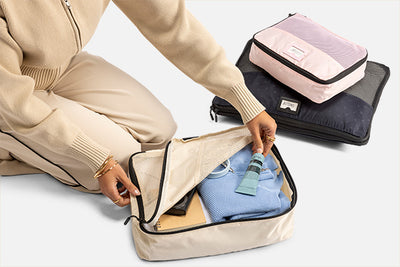
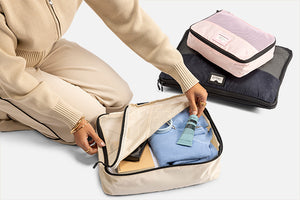
When clothes are laid flat, they are easier to layer. When you use packing cubes, each group of clothes becomes its own neat section.
One cube for tops. One for underwear. One for activewear or extras.
Because the backpack opens flat, those cubes are easy to see and easy to move. You are not pulling one cube out just to find another cube underneath it.
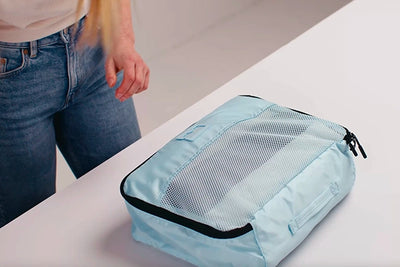
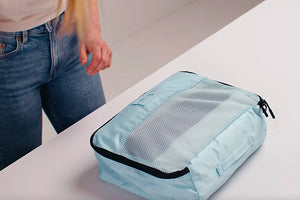
Pairing a clamshell backpack with compression packing cubes makes the system even stronger. The cubes keep each group tidy. The clamshell opening keeps each cube visible.
Together, they make the bag easier to pack, easier to access, and easier to keep organised through the whole trip.
Can you travel for two weeks with one clamshell backpack?
Yes, but the answer needs to be honest.
A clamshell backpack does not magically create more space. The design does not let you pack two full weeks of fresh outfits into a carry-on backpack. What it does is make a smart packing system easier to manage.
For many travellers, two weeks from one backpack means packing for one week, re-wearing outfits, and washing once mid-trip.
The bag’s capacity gets you a week. The method gets you two. That method usually has three parts:
-
a capsule wardrobe with pieces that work together
-
a willingness to re-wear some outfits
-
one mid-trip wash, either at a laundromat or in a hotel sink for lighter items
The clamshell design helps because your clothes stay visible. You can see what you have already worn. You can see what still works together. You can see what needs washing.
That is much harder when your clothes are buried in a column and you can only see the top layer of the bag.
A mid-30-litre clamshell backpack will not hold two full weeks of fresh outfits. But it can hold one smart week of clothes, especially when packed flat in cubes.
With one wash, that can become two weeks of travel.
When a clamshell backpack may not be right
A clamshell backpack is not perfect for every traveller or every trip.
The biggest trade-off is that it works best when you have a flat surface. A hotel bed works. An airport floor works. A luggage rack works. Even a clean bench can work. A narrow overhead locker does not.
If you often need to open your bag while standing, sitting on a kerb, or reaching into it in a tight space, you may not get the full benefit of the design.
The second trade-off is that a clamshell backpack rewards organised packing. It will not organise your bag for you.
If you throw everything in loosely, it can still become messy. But if you use packing cubes or place items in clear sections, the design helps that order last longer.
That is the honest difference.
A top-loading backpack can still make sense for hiking, trekking, camping or situations where you need quick top access while standing. For hotel-based travel, city travel, work travel and carry-on-only packing, a clamshell backpack is usually easier to live out of.
What to look for in a clamshell travel backpack
Not every backpack that claims to be a clamshell works the same way. Here is what to look for.
A full wraparound zip: A true clamshell backpack should open around three sides of the bag. Some bags only open part of the way. They may look like clamshells in photos, but they do not lie fully flat. If the opening is too small, you lose the main benefit. Look for a full wraparound zip that lets the bag open wide, like a suitcase.
Internal compression straps: When a clamshell backpack is open, your clothes are laid flat. But when you close the bag and carry it upright, the contents can shift. Internal compression straps help hold everything in place. They stop clothes and packing cubes from falling into the bottom of the bag while you walk, and they also help the backpack keep its shape.
A mesh retaining panel: A mesh retaining panel is especially useful on the lid side of the bag. Without it, items in the top half can fall forward when you open the backpack. With it, the bag opens cleanly and the contents stay where they belong. You can see what is inside, but everything is still held in place.
A separate tech compartment: The main clothes compartment works best when it is used for clothes, packing cubes and travel items. Your laptop should not need to live in the same space. A separate tech compartment lets you reach your laptop, tablet, charger or documents without opening the main clamshell section. This is useful at airport security, in cafés, on planes and during work trips. It also means your clothes section stays undisturbed during the day.
A comfortable carry system: A travel backpack may pack like a suitcase, but you still have to carry it. Look for padded shoulder straps, a supportive back panel, and a sternum strap or hip belt if you plan to walk longer distances with the bag. This matters in airports, train stations and city streets, especially when the bag is packed close to the carry-on weight limit. A good clamshell design helps with packing. A good harness helps with carrying. You need both.
A lighter bag to begin with: For Australian carry-on travel, empty weight matters. Many Australian airlines have a 7 kg carry-on allowance. Every gram the bag weighs empty is a gram you cannot use for clothes, shoes, tech or toiletries. As a guide, look for a travel backpack under about 1.6 kilograms if possible. The lighter the bag is before you pack it, the more useful your carry-on allowance becomes.
Useful expansion: Expansion can be helpful if you want a little flexibility. You may leave home with the bag packed neatly, then return with extra items, laundry, gifts or shopping. An expandable section gives you more space when you need it, without forcing you to carry a larger bag all the time. The key is balance. Expansion is useful, but the bag should still carry well and stay within the size and weight limits you need to follow.
Meet the Road Warrior
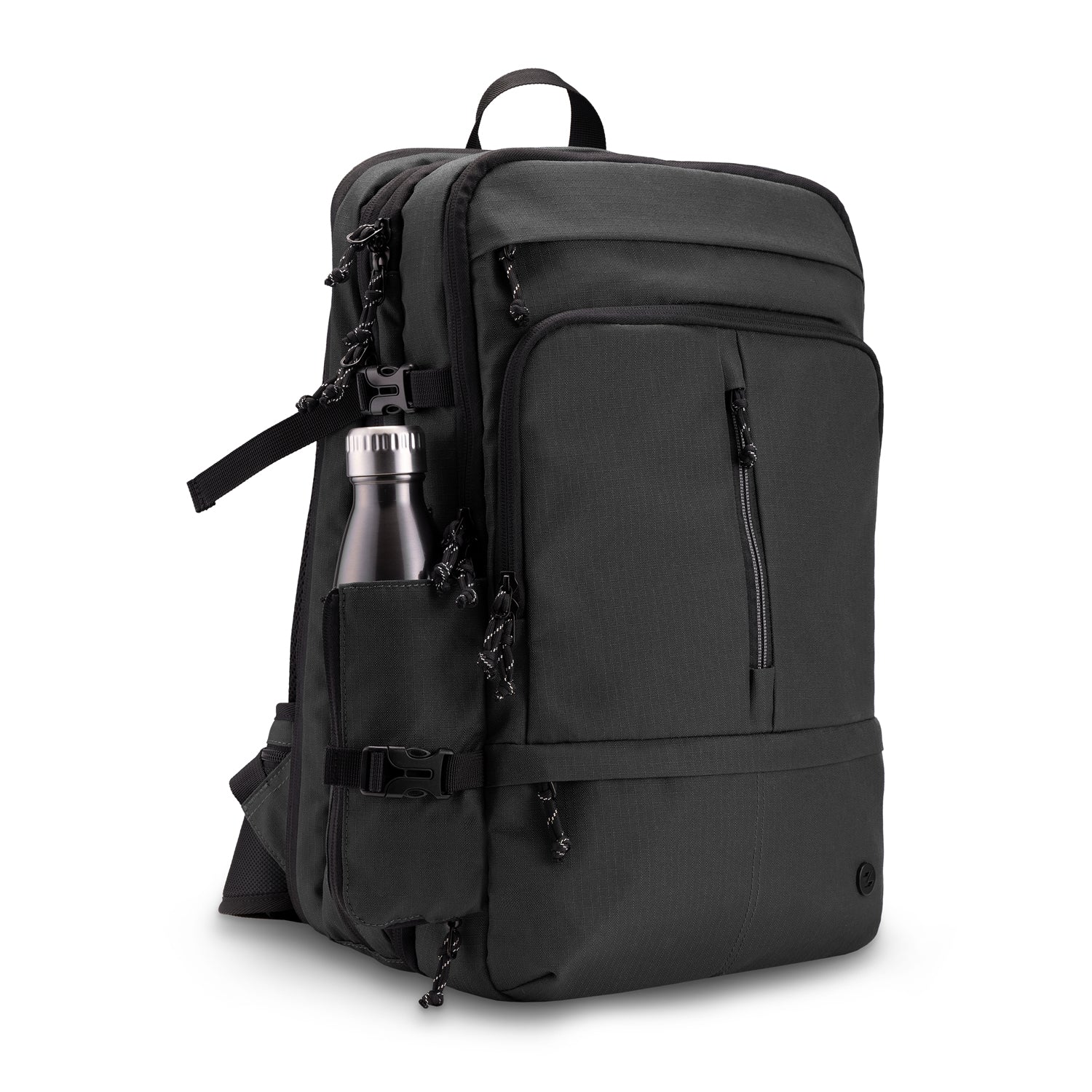
The Road Warrior Backpack was designed for travellers who want a backpack that packs like a suitcase, but carries like a backpack.
Designed in-house in Melbourne, the Road Warrior was built around a simple travel idea: a backpack should be as easy to pack as a suitcase.
The main compartment is a true clamshell. It has a full wraparound zip, opens completely flat, and gives you a clear view of your clothes and packing cubes. Internal compression straps help hold everything in place, while the mesh retaining panel on the lid keeps items secure when the bag is open.
The clothes compartment is designed for clothes and packing cubes. The tech compartment is separate.
That means you can access the padded 17-inch laptop sleeve and organised tech panel without opening the main clamshell section. Your laptop, tablet, documents and chargers stay easy to reach, while your packed clothes stay untouched.
The bag weighs 1.48 kilograms empty and expands from 28 litres to 36 litres.
That gives you a lighter starting point for Australian carry-on limits, with extra space when you need it for the return trip.
For travellers who want carry-on freedom without giving up suitcase-style organisation, that is the real point of the Road Warrior: less digging, less repacking, and a bag that stays organised across the whole trip.
Is a clamshell backpack better than a top-loading backpack?
For hotel-based travel, city trips, work travel and carry-on packing, a clamshell backpack is usually easier to pack and access. A top-loading backpack can still be better for hiking, trekking or situations where you need to open the bag while standing. The better choice depends on how you travel.
What is the difference between a clamshell backpack and a front-loading backpack?
The terms are often used to describe the same idea. A clamshell backpack, front-loading backpack or panel-loader backpack opens from the front instead of only from the top. A true clamshell opens wide and lies flat like a suitcase.
Are clamshell backpacks good for carry-on travel?
Yes, especially if they are lightweight and fit airline size limits. For Australian carry-on travel, empty weight is especially important because many airlines have a 7 kg carry-on allowance. The lighter the backpack is empty, the more weight you have left for the things you actually need to pack.
Do packing cubes work well in a clamshell backpack?
Yes. Packing cubes work especially well in a clamshell backpack because the bag opens flat. That means you can see each cube clearly instead of stacking them vertically inside a deep compartment. Compression packing cubes can also help reduce bulk and keep each group of clothes tidy.
Can you travel for two weeks with a clamshell backpack?
Yes, but usually not by packing two full weeks of fresh clothes. A more realistic method is to pack for one week, re-wear outfits, and wash once during the trip. The clamshell design helps because your clothes stay visible and organised, making that system easier to manage.
What should I look for in a clamshell travel backpack?
Look for a full wraparound zip, internal compression straps, a mesh retaining panel, a separate laptop or tech compartment, a comfortable carry system, and a light starting weight. These features help the bag pack well, carry well, and stay organised during the trip.


Leave a comment